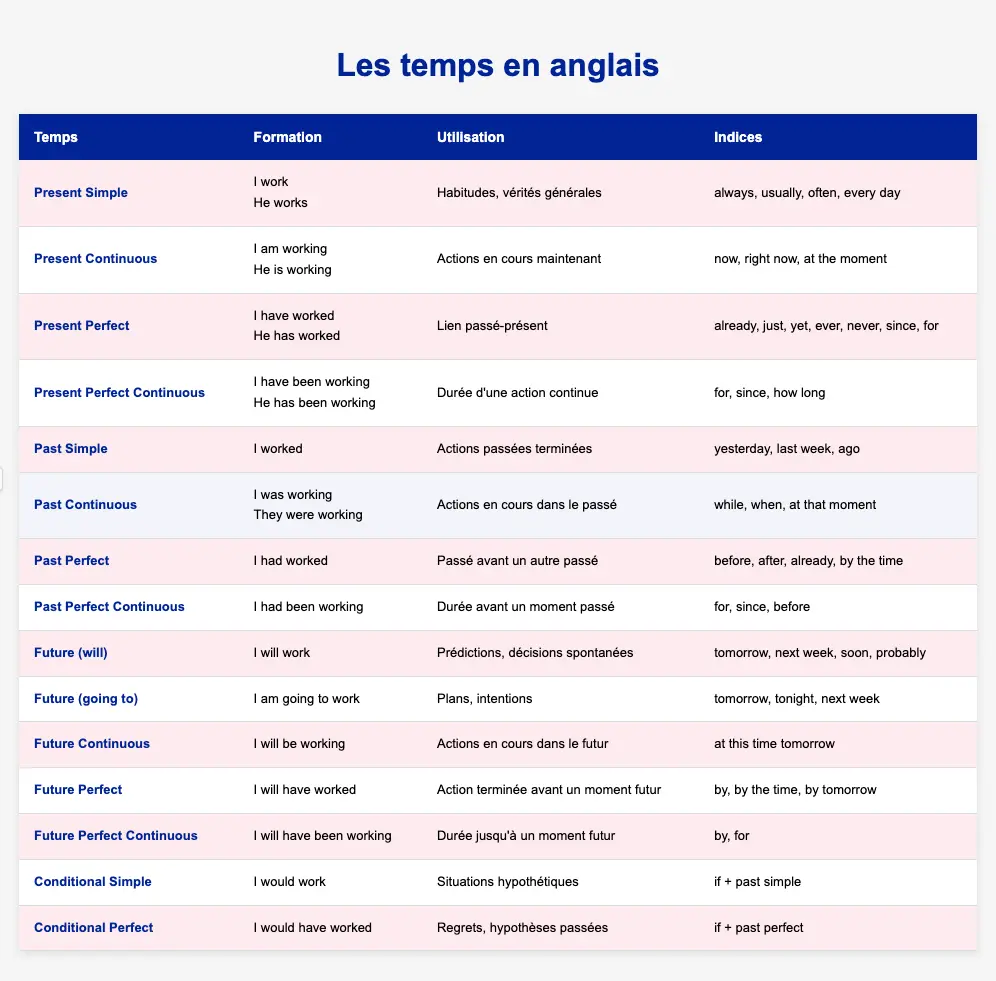
Tableau des temps en Anglais
| Temps/Tense | Affirmative/Negative/Question | Cas d’utilisation | Indices d’utilisation |
|---|---|---|---|
| Present Simple | Aff: I/You/We/They work He/She/It works Neg: I/You/We/They don’t work He/She/It doesn’t work Q: Do I/you/we/they work? Does he/she/it work? | Actions habituelles, vérités générales, faits permanents | always, usually, often, sometimes, never, every day/week/month, on Mondays |
| Present Continuous | Aff: I am working You/We/They are working He/She/It is working Neg: I am not working You/We/They aren’t working He/She/It isn’t working Q: Am I working? Are you/we/they working? Is he/she/it working? | Actions en cours au moment présent, situations temporaires, arrangements futurs | now, right now, at the moment, currently, today, this week, Look!, Listen! |
| Present Perfect Simple | Aff: I/You/We/They have worked He/She/It has worked Neg: I/You/We/They haven’t worked He/She/It hasn’t worked Q: Have I/you/we/they worked? Has he/she/it worked? | Actions passées avec résultat présent, expériences de vie, actions non datées | already, just, yet, ever, never, so far, up to now, recently, lately, since, for |
| Present Perfect Continuous | Aff: I/You/We/They have been working He/She/It has been working Neg: I/You/We/They haven’t been working He/She/It hasn’t been working Q: Have I/you/we/they been working? Has he/she/it been working? | Actions commencées dans le passé et continuant maintenant, accent sur la durée | for, since, how long, all day/week, lately, recently |
| Past Simple | Aff: I/You/He/She/It/We/They worked Neg: I/You/He/She/It/We/They didn’t work Q: Did I/you/he/she/it/we/they work? | Actions terminées à un moment précis du passé, habitudes passées | yesterday, last week/month/year, ago, in 1990, when I was young |
| Past Continuous | Aff: I/He/She/It was working You/We/They were working Neg: I/He/She/It wasn’t working You/We/They weren’t working Q: Was I/he/she/it working? Were you/we/they working? | Actions en cours à un moment précis du passé, actions interrompues, actions simultanées | while, when, at that moment, at 5 o’clock yesterday, all day yesterday |
| Past Perfect Simple | Aff: I/You/He/She/It/We/They had worked Neg: I/You/He/She/It/We/They hadn’t worked Q: Had I/you/he/she/it/we/they worked? | Action passée antérieure à une autre action passée | before, after, already, just, by the time, when, until |
| Past Perfect Continuous | Aff: I/You/He/She/It/We/They had been working Neg: I/You/He/She/It/We/They hadn’t been working Q: Had I/you/he/she/it/we/they been working? | Durée d’une action jusqu’à un moment du passé | for, since, how long, before |
| Future Simple (will) | Aff: I/You/He/She/It/We/They will work Neg: I/You/He/She/It/We/They won’t work Q: Will I/you/he/she/it/we/they work? | Prédictions, décisions spontanées, promesses, offres | tomorrow, next week/month/year, in the future, soon, probably, perhaps, I think, I hope |
| Future Simple (going to) | Aff: I am going to work You/We/They are going to work He/She/It is going to work Neg: I’m not going to work You/We/They aren’t going to work He/She/It isn’t going to work Q: Am I going to work? Are you/we/they going to work? Is he/she/it going to work? | Intentions, plans préétablis, prédictions basées sur des preuves présentes | tomorrow, next week, tonight, this evening, Look! (pour prédictions) |
| Future Continuous | Aff: I/You/He/She/It/We/They will be working Neg: I/You/He/She/It/We/They won’t be working Q: Will I/you/he/she/it/we/they be working? | Actions en cours à un moment futur précis | at this time tomorrow, at 5pm tomorrow, this time next week |
| Future Perfect Simple | Aff: I/You/He/She/It/We/They will have worked Neg: I/You/He/She/It/We/They won’t have worked Q: Will I/you/he/she/it/we/they have worked? | Actions qui seront terminées avant un moment futur | by, by the time, by tomorrow/next week, until, before |
| Future Perfect Continuous | Aff: I/You/He/She/It/We/They will have been working Neg: I/You/He/She/It/We/They won’t have been working Q: Will I/you/he/she/it/we/they have been working? | Durée d’une action jusqu’à un moment futur | by, by the time, for (+ durée) |
| Conditional Simple | Aff: I/You/He/She/It/We/They would work Neg: I/You/He/She/It/We/They wouldn’t work Q: Would I/you/he/she/it/we/they work? | Situations hypothétiques, demandes polies, conseils | if + past simple, would like, could, should |
| Conditional Perfect | Aff: I/You/He/She/It/We/They would have worked Neg: I/You/He/She/It/We/They wouldn’t have worked Q: Would I/you/he/she/it/we/they have worked? | Situations hypothétiques passées non réalisées | if + past perfect, should have, could have |
Les temps du présent
Le present simple
Ce temps exprime les habitudes, les vérités générales et les faits permanents. Formation :- Forme affirmative : sujet + verbe (+ s à la 3ème personne du singulier)
- Forme négative : sujet + do/does + not + verbe
- Forme interrogative : Do/Does + sujet + verbe ?
- She works in a hospital.
- They don’t eat meat.
- Do you speak French?
Le present continuous
Ce temps décrit une action qui se déroule au moment où l’on parle ou une situation temporaire. Formation : sujet + verbe être (am/is/are) + verbe-ing Exemples :- I am reading a book right now.
- She is not working today.
- Are they coming to the party?
Le present perfect simple
Ce temps établit un lien entre le passé et le présent. L’action passée a encore des conséquences maintenant. Formation : sujet + have/has + participe passé Exemples :- I have visited Paris three times.
- He has never eaten sushi.
- Have you finished your homework?
Le present perfect continuous
Ce temps insiste sur la durée d’une action qui a commencé dans le passé et qui continue encore. Formation : sujet + have/has + been + verbe-ing Exemples :- I have been studying English for five years.
- They have been waiting for two hours.
- Has she been crying?
Les temps du passé
Le past simple
Ce temps décrit des actions complètement terminées dans le passé, sans lien avec le présent. Formation :- Verbes réguliers : verbe + ed
- Verbes irréguliers : forme spécifique
- She walked to school yesterday.
- They didn’t go to the cinema.
- Did you see the match?
Le past continuous
Ce temps décrit une action qui était en cours à un moment précis du passé. Formation : sujet + was/were + verbe-ing Exemples :- I was sleeping when you called.
- They were watching TV at 8pm.
- Was she working last night?
Le past perfect simple
Ce temps exprime une action passée qui s’est déroulée avant une autre action passée. Formation : sujet + had + participe passé Exemples :- When I arrived, the train had already left.
- She had never seen snow before moving to Canada.
- Had they finished dinner when you arrived?
Le past perfect continuous
Ce temps souligne la durée d’une action passée qui s’est déroulée avant un autre moment du passé. Formation : sujet + had + been + verbe-ing Exemples :- I had been working for 12 hours when I finally went home.
- They had been living in London for ten years before they moved.
Les temps du futur
Le future simple avec “will”
Ce futur exprime des prédictions, des décisions spontanées, des promesses ou des offres. Formation : sujet + will + verbe à l’infinitif Exemples :- I will help you with your homework.
- It will rain tomorrow.
- Will you come to my party?
Le future avec “going to”
Ce futur indique une intention planifiée ou une prédiction basée sur des indices présents. Formation : sujet + am/is/are + going to + verbe Exemples :- We are going to visit our grandparents next week.
- Look at those clouds! It is going to rain.
- Are you going to study tonight?
Le future continuous
Ce temps décrit une action qui sera en cours à un moment précis du futur. Formation : sujet + will + be + verbe-ing Exemples :- This time tomorrow, I will be flying to New York.
- They will be watching the game at 8pm.
Le future perfect
Ce temps exprime une action qui sera complétée avant un moment précis du futur. Formation : sujet + will + have + participe passé Exemples :- By next year, I will have graduated.
- They will have finished the project by Friday.
Le future perfect continuous
Ce temps met l’accent sur la durée d’une action qui sera en cours jusqu’à un moment du futur. Formation : sujet + will + have + been + verbe-ing Exemples :- By December, I will have been working here for five years.
- Next month, they will have been living in Paris for a decade.
Les conditionnels
Le conditional simple
Le conditionnel simple exprime des situations hypothétiques, des demandes polies ou des conseils. Formation : sujet + would + verbe à l’infinitif Exemples :- If I had money, I would travel the world.
- Would you like some coffee?
- I would recommend this restaurant.
Le conditional perfect
Ce temps exprime des regrets ou des situations hypothétiques dans le passé qui ne se sont pas réalisées. Formation : sujet + would + have + participe passé Exemples :- If I had studied harder, I would have passed the exam.
- She would have come if you had invited her.
Comment choisir le bon temps
Quelques questions à se poser :- Quand l’action se déroule-t-elle ? (passé, présent, futur)
- L’action est-elle terminée ou en cours ?
- Y a-t-il un lien avec un autre moment ?
- Faut-il insister sur la durée ?
Différence entre present perfect et past simple
C’est l’une des difficultés majeures :- Past simple : moment précis du passé mentionné → “I went to Paris in 2019.”
- Present perfect : pas de moment précis, lien avec maintenant → “I have been to Paris three times.”
Différence entre will et going to
- Will : décision prise au moment où l’on parle → “I’ll help you!”
- Going to : décision déjà prise, plan → “I’m going to study medicine.”
Exercice : testez vos connaissances
Choisissez la bonne réponse pour chaque question :
Question 1 : She _____ in a hospital.
Question 2 : I _____ English for five years.
Question 3 : They _____ TV when I called.
Question 4 : Look at those clouds! It _____ rain.
Question 5 : When I arrived, the train _____ already _____.
Question 6 : She _____ a book right now.
Question 7 : By next year, I _____ my studies.
Question 8 : I _____ to Paris in 2019.
Question 9 : If I had money, I _____ a car.
Question 10 : They _____ in London for ten years before they moved.